
Razor Blade Throat and the 2026 Summer COVID Wave: What You Need to Know
It is late. Closer to midnight than you would like to admit. Swallowing feels like dragging glass down the back of your throat, and every article you pull up on your phone keeps using the same phrase you have started using in your head: razor blade throat.
You are not imagining it, and you are not being dramatic. This summer's COVID wave has a signature symptom, and if your throat hurts more than a normal cold ever has, you are probably right to suspect COVID before anything else.
Here is what is actually driving the 2026 summer COVID wave, why it feels different depending on your age, and what to do about it tonight, not next week.
What Is Actually Driving This Summer's COVID Wave
Two variants are doing most of the work this summer, and they behave differently enough that it is worth knowing both by name.
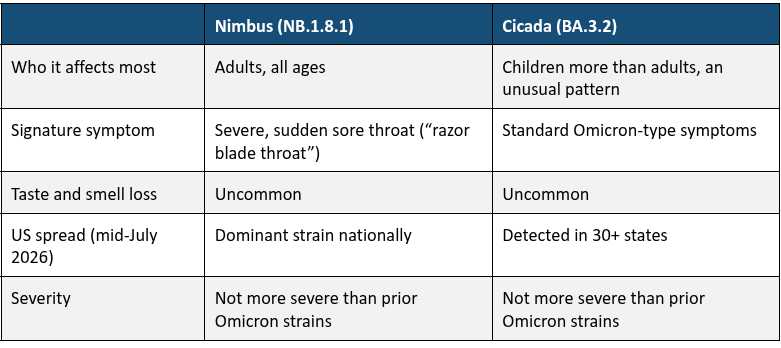
The first is NB.1.8.1, nicknamed Nimbus. It became the dominant strain in the US in 2025 and has held that position into summer 2026. As of mid-July, CDC epidemic trend modeling estimated COVID infections were growing or likely growing in at least 27 states. National test positivity stood at 4.8 percent, up about a percentage point from the week before, with emergency department visits rising across all age groups. Nine states, concentrated in the South and West, were reporting moderate to very high COVID levels in wastewater, including Idaho, Nevada, and Oregon, three of the states Practical Telehealth already serves.
CDC's 2026 Summer Outlook flagged the South and West specifically well before this wave took hold, since lower COVID activity in those regions last winter left less recent population immunity heading into summer travel season.
The second variant is BA.3.2, nicknamed Cicada. It carries an unusually high number of spike protein mutations, more than 70, which is part of why virologists are watching it closely. Cicada has been detected in more than half of US states and appears to infect children more readily than adults, a reversal of the pattern seen through most of the pandemic.
Neither variant appears to cause more severe disease than the Omicron strains that came before them. But “not more severe” does not mean “not worth treating,” especially if you are over 65, immunocompromised, pregnant, or managing a chronic condition like asthma or diabetes.
Razor Blade Throat: Why This Symptom Feels So Different

If you have had COVID before, this may not feel like your last infection. Loss of taste and smell, once the hallmark symptom, is far less common with Nimbus. What has taken its place is a sore throat severe enough that people describe swallowing water like it is broken glass.
Alongside the sore throat, Nimbus typically brings fever, fatigue, dry cough, nasal congestion, and muscle aches. The absence of taste and smell loss is exactly why so many people mistake it for strep throat or a bad cold and wait longer than they should to get evaluated.
The pain is real, and it is a genuinely useful signal. But it is not a diagnosis by itself. A sore throat this severe deserves an actual look from a licensed provider, if only to rule out strep and make sure you are not dealing with two things at once.
Nimbus vs. Cicada: A Quick Comparison
Pro tip: If your child has a fever and congestion that feels more intense than a typical summer cold, and it is moving through their friend group or daycare, treat it as a real possibility of COVID rather than “just a bug going around.” Testing takes minutes and changes what you do next.
If You Have Kids: Why This Summer Looks Different for Them

Most of the pandemic trained parents to worry more about grandparents than kids. Cicada complicates that. Early data suggests it may infect children between roughly 3 and 15 more easily than adults, possibly because kids have built up less immunity to this particular set of mutations, or simply because of how much close contact they have with each other over the summer.
The reassuring part: outcomes in children have generally stayed mild to moderate, similar to other Omicron strains. The part that matters for you as a parent: mild does not mean ignore it. A feverish, congested, miserable kid in July still needs an actual evaluation, both to rule out other summer illnesses and to catch anything that needs more than fluids and rest.
Is It COVID, a Cold, or Strep? How to Tell
Here is the uncomfortable truth: you often cannot tell by symptoms alone. Nimbus and Cicada largely skip the classic loss of taste and smell, which means this summer's COVID can look a lot like a bad cold, the flu, or strep throat on the surface.
What tends to separate COVID from an ordinary summer cold:
A sore throat severe enough to make swallowing genuinely painful, not just scratchy
Fatigue that feels disproportionate to how sick you otherwise feel
Fever and muscle aches showing up together, rather than just one
Symptoms starting two to five days after a known exposure, like travel or a large gathering
If your main complaint is congestion and general misery without the severe throat pain, it may be a more ordinary summer virus, and a virtual cold and flu visit can sort that out just as quickly. But when in doubt, test. A rapid test at home or a provider-ordered lab test through online lab orders settles it in minutes, not days.
The Real Cost of Waiting

Untreated COVID does not usually get dramatically worse for most healthy adults. But “usually” is doing a lot of work in that sentence if you are over 65, pregnant, immunocompromised, or managing a chronic condition, since delayed treatment closes the window on antiviral options that only work when started early.
There is also the more ordinary cost: a full week of misery instead of a few days, a missed work week instead of a missed day, and the same decision you have probably made before, sitting in an urgent care waiting room for 90 minutes to be told what you already suspected.
An urgent care visit for a respiratory illness evaluation commonly runs $150 to $250 before any treatment. A same-day virtual visit built for exactly this situation costs $20 flat, no insurance needed, and does not require you to leave the house you are already too tired to leave.
What Actually Helps

For most healthy people, COVID from either variant resolves with rest, fluids, and over-the-counter relief for fever and throat pain. Salt water gargles, throat lozenges, and staying ahead of hydration matter more than people expect when swallowing hurts this much.
For people at higher risk of severe illness, antiviral treatment like Paxlovid can meaningfully lower the risk of hospitalization, but it has to start within days of symptom onset to work. This is exactly the kind of decision that benefits from a same-day visit rather than a wait-and-see approach, since the treatment window closes fast.
A licensed provider can evaluate your symptoms, risk factors, and test result, and determine whether antiviral treatment is appropriate for your specific situation. And if symptoms linger well past the acute phase, an online primary care visit can pick up where this leaves off.
Most people start feeling noticeably better within 5 to 7 days, though the sore throat itself can be the slowest symptom to fade, sometimes lingering a day or two after everything else has calmed down.
When to Seek Immediate, In-Person Care

A virtual visit is built for the situation most people are actually in this summer: uncomfortable, contagious, and needing a fast, accurate answer. It is not a substitute for emergency care. Seek in-person or emergency evaluation right away for:
Trouble breathing or shortness of breath at rest
Persistent chest pain or pressure
Confusion or difficulty staying awake
Bluish lips or face
A fever that will not come down despite medication, especially in a young child or an older adult
Where Vaccines Fit In This Summer
Current CDC guidance for the 2025 to 2026 season recommends COVID-19 vaccination based on shared decision-making between you and a provider for people ages 6 months to 64, with the clearest benefit for those at higher risk of severe illness. For adults 65 and older, vaccination is also recommended on an individual basis. If you are not sure where you fall, or whether a booster makes sense given an upcoming trip or a chronic condition, that conversation is worth having before you are already sick, not after.
How a $20 Virtual Visit Actually Works
You do not need to convince anyone that your throat really does feel like razor blades. That is the whole point.
Practical Telehealth was built by Casey Hicks, FNP-BC, a board-certified Family Nurse Practitioner, specifically because patients kept describing the same frustration: a problem they could identify in thirty seconds, met with a system that required hours to confirm it.
Here is what actually happens:
Check that your state is covered. It takes about ten seconds.
Describe what you are feeling, in your own words, at whatever hour it actually is.
A licensed provider reviews your case.
If appropriate, your prescription is sent straight to your pharmacy, often within the hour.
The flat fee is $20. No insurance required, no waiting room, and no explaining your symptoms twice to two different people before anyone actually treats you.
Frequently Asked Questions

What does “razor blade throat” actually feel like?
It describes a sore throat severe enough that swallowing, even water, causes sharp pain rather than the usual scratchy discomfort of a cold. It has been reported with the Nimbus (NB.1.8.1) variant and is often the most noticeable symptom, sometimes appearing alongside only mild congestion or fatigue.
Is the Cicada variant more dangerous for children?
No. Cicada (BA.3.2) does appear to infect children more easily than earlier variants, but reported outcomes in kids have stayed mild to moderate, similar to other Omicron strains. It is worth an evaluation, not panic.
How can I tell if my sore throat is COVID or strep?
Symptoms alone are not reliable, since both cause severe throat pain. A rapid COVID test plus a strep swab, done together, is the fastest way to know which one you are actually dealing with.
Can I get Paxlovid through a virtual visit?
Yes, if a licensed provider determines it is appropriate based on your symptoms, test result, and risk factors. Antiviral treatment works best when started within the first few days of symptoms, which is why a same-day evaluation matters.
Do I need a COVID vaccine again this year?
Current guidance recommends a shared decision between you and a provider, with the strongest benefit for people 65 and older or with higher-risk health conditions. A provider can help you weigh that decision based on your specific history.
How long does razor blade throat last?
For most people, the worst of the throat pain eases within 3 to 5 days as other symptoms improve, though it can be the last symptom to fully resolve. If severe pain lasts longer than a week, or you develop a high fever or trouble swallowing fluids, it is worth a follow-up evaluation.
The Bottom Line

Razor blade throat is not in your head, the summer wave is real, and two variants are behind it for two different reasons. None of that requires an ER visit or a 90-minute wait to sort out. It requires an honest look from someone qualified to give you one.
Book a virtual COVID-19 visit tonight for $20, and get an actual answer instead of another night of guessing.
