
Quit Smoking Medication Online: How to Get a Prescription Today
You already made the decision. Maybe it happened somewhere between your first cigarette of the day and your third cup of coffee, when the whole ritual suddenly felt exhausting instead of comforting. Maybe a doctor said something you cannot unhear, or a birthday landed differently this year, or you just woke up done negotiating with yourself about “one more pack.” Whatever the trigger was, the hard part, the actual decision to quit, is already behind you.
What happens in the next day or two matters more than most people realize. Motivation to quit smoking has a shelf life. According to the Centers for Disease Control and Prevention, roughly two out of three adults who smoke say they want to quit, and about half make a real attempt in any given year, but fewer than one in ten actually succeed. One of the biggest reasons for that gap is not a lack of willpower. It is a lack of treatment. Fewer than 40 percent of people who try to quit use FDA-approved medication or counseling while doing it, even though combining the two produces the best documented outcomes.
This guide covers the three FDA-approved medication paths for quitting smoking, how each one actually works, and how to get evaluated and prescribed today, without waiting weeks for a primary care appointment.
Why the First Few Days Are the Hardest Part to Get Right

Nicotine reaches the brain within about ten seconds of inhaling cigarette smoke, faster than most other addictive substances reach the brain through any other route. That speed is a large part of why nicotine dependence forms so quickly, and why quitting cold, with nothing but willpower, works for so few people on the first try.
Withdrawal symptoms, including irritability, difficulty concentrating, increased appetite, and intense cravings, tend to peak within the first three days after the last cigarette and gradually ease over the following two to four weeks. Medication does not eliminate that process, but it changes how survivable it feels, which is often the actual difference between a quit attempt that sticks and one that quietly ends on day four.
The Three FDA-Approved Ways to Quit With Medication

There is no single medication that works best for everyone. There are three evidence-based categories, and the right one depends on smoking history, health background, and what has or has not worked before.
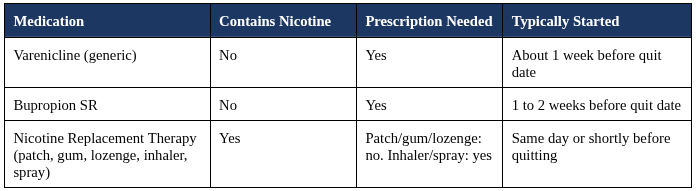
Key takeaway: Varenicline and bupropion SR are prescription medications that do not contain nicotine and are usually started one to two weeks before a planned quit date. Nicotine replacement therapy (such as patches, gum, lozenges, inhalers, or sprays) contains nicotine and is typically started on or just before the day you quit smoking.
Varenicline (the generic that replaced Chantix)
Varenicline works by attaching to the same brain receptors that nicotine does. This does two things at once: it eases withdrawal symptoms by giving those receptors some of the stimulation they are used to, and it blocks nicotine from binding fully if a cigarette is smoked anyway, which dulls the reward and makes a slip less likely to turn into a full relapse.
The brand name Chantix was pulled from the market in 2021 after manufacturing tests found elevated levels of a nitrosamine impurity. Generic varenicline, made by other manufacturers, has been FDA-approved since August 2021 and remains available by prescription. It is generally recommended as a first-line option because clinical evidence shows it tends to be more effective than bupropion or a single form of nicotine replacement therapy used alone. It is usually started about a week before the quit date and continued for 12 weeks, sometimes longer depending on how the attempt is going.
Bupropion (Zyban / generic bupropion SR)
Bupropion contains no nicotine. It is the same active compound marketed under the brand name Wellbutrin for depression, though the smoking-cessation formulation and twice-daily dosing schedule is specific to quitting. Researchers are not entirely sure why it reduces the urge to smoke, but it reliably does, and it can roughly double a person's chance of quitting successfully compared with no medication at all.
Bupropion is typically started one to two weeks before the quit date and can be combined with nicotine replacement therapy for a stronger effect. It is not the right option for everyone; people with a seizure disorder or a current or past eating disorder diagnosis should not use it, which is exactly the kind of history a licensed provider needs to review before writing the prescription.
Nicotine Replacement Therapy (NRT)
NRT delivers nicotine without the thousands of other chemicals in cigarette smoke, including the specific compounds linked to cancer risk. There are five FDA-approved forms: the patch, gum, lozenge, nasal spray, and inhaler. The patch, gum, and lozenge are available over the counter. The nasal spray and inhaler require a prescription because they deliver nicotine faster, closer to the speed of a cigarette, which makes them useful for breakthrough cravings but also means they call for more clinical oversight.
Combining a long-acting form, the patch, with a short-acting form, gum or lozenge, is consistently shown to work better than using any single NRT product alone, because it addresses both the steady baseline craving and the sudden spikes.
Why Medication Plus a Plan Beats Medication Alone

CDC survey data on adults who attempted to quit found that only about 1 in 20 used both counseling and medication together, even though that combination produces the best documented outcomes. Medication addresses the physical side of nicotine dependence. A plan, built with a provider who understands smoking history, triggers, and previous quit attempts, addresses the behavioral side: what to do at 3pm when the craving hits, what to expect on day three, what the backup plan is if a stressful week threatens the whole attempt.
This is also where a previous unsuccessful quit attempt becomes useful information instead of a discouraging memory. If bupropion alone did not work two years ago, that tells a provider something. Combining it with NRT, or trying varenicline instead, is a reasonable next step, not starting over from zero.
Getting a Prescription Without an In-Person Visit

The standard path to any of these medications usually starts with a primary care appointment, which in many parts of the country means a multi-week wait, a copay, and a conversation squeezed into a 15-minute slot. None of that matches the moment most people are actually in, which is: the decision was made today, and the plan is to start now.
Practical Telehealth's online smoking cessation program is built around that specific moment. The process starts with a description of smoking history, previous quit attempts, and general health background. A licensed provider, working under Casey Hicks, FNP-BC, reviews it and builds a cessation plan that may include a prescription for varenicline, bupropion, or prescription-strength NRT, sent directly to the pharmacy. The visit is a flat $20, no insurance required, and most plans are ready within hours rather than weeks.
For comparison, a primary care copay for a single visit is commonly in the $25 to $75 range even with insurance, and a walk-in urgent care visit to discuss a new prescription without an established relationship can run well past $150. The $20 flat fee is not a discount version of that visit. It is the same clinical decision, made by a licensed provider, minus the waiting room.
What to Expect in the First Few Weeks

Days 1 to 3: Cravings and irritability are usually at their most intense. This is also, not coincidentally, when most unsupported quit attempts fail.
Week 1 to 2: For anyone who started bupropion or varenicline before the quit date as directed, this is roughly when the medication reaches full effect.
Weeks 2 to 4: Physical withdrawal symptoms typically continue to ease. Cravings shift from being mostly about physical withdrawal to being mostly about habit and situational triggers, a specific chair, a specific coworker, a specific drive.
Beyond 12 weeks: Most cessation medication courses are designed to run this long, sometimes longer, specifically because habit-based cravings can outlast physical withdrawal by months.
A follow-up conversation with a provider partway through the process is not a formality. It is the point where a medication gets adjusted, a side effect gets addressed, or a plan gets reinforced before a hard week turns into a relapse.
Frequently Asked Questions

What is the most effective medication to quit smoking?
Clinical research comparing the FDA-approved options generally finds varenicline to be more effective than bupropion or a single form of nicotine replacement therapy used alone, since it both eases withdrawal and blunts the reward if a relapse cigarette is smoked. The right choice still depends on personal health history, which a licensed provider should confirm before prescribing.
Can I still get varenicline (the medication sold as Chantix) prescribed online?
Yes. The brand name Chantix was discontinued in 2021, but generic varenicline remains FDA-approved and available by prescription. A licensed provider can prescribe it after a telehealth visit that reviews smoking and health history, without an in-person appointment.
How long do I need to take smoking cessation medication?
Varenicline is typically started about a week before the quit date and continued for 12 weeks, sometimes longer. Bupropion usually starts one to two weeks before quitting and continues for at least 7 to 12 weeks. A provider tailors the exact timeline to the individual.
Is nicotine replacement therapy safer than prescription medication?
Both are considered far safer than continuing to smoke. NRT delivers nicotine without the thousands of other chemicals in cigarette smoke, while varenicline and bupropion contain no nicotine at all and work through different mechanisms in the brain. A provider can help decide which fits a given health history.
What if a previous quit attempt did not work?
Most people who quit successfully tried more than once first. A previous unsuccessful attempt is useful clinical history, not a failure, and it helps a provider choose a different medication or combination this time, such as pairing bupropion with nicotine replacement therapy.
The Window Is Open Right Now

The decision to quit does not stay at full strength forever. It is strongest right now, close to whatever prompted it in the first place. FDA-approved medication, whether that is varenicline, bupropion, or a properly combined nicotine replacement plan, gives that decision the best possible chance of holding.
A licensed provider can review your history and start a prescription plan today for a flat $20, with no waiting room and no weeks-long gap between the decision and the first real step toward acting on it. Start your online smoking cessation visit.
