
That Burning Feeling When You Pee Is Not Something You Should Wait Out
By a UTI (typically trimethoprim-sulfamethoxazole or nitrofurantoin). Getting the wrong one treats nothing. You can get an evaluation and prescription for both through Practical Telehealth's UTI, BV, and yeast infection service.
Vaginal Yeast Infection
Caused by an overgrowth of the fungus Candida. Almost entirely vaginal in location. The hallmark is intense itching and irritation at the vaginal opening and vulva, combined with a thick, white, cottage-cheese-like discharge that has no odor. Burning when urinating can occur in a yeast infection, but it is external, from urine touching inflamed skin, not internal.
A yeast infection requires an antifungal medication. Antibiotics will not touch it.
QUICK SYMPTOM COMPARISON
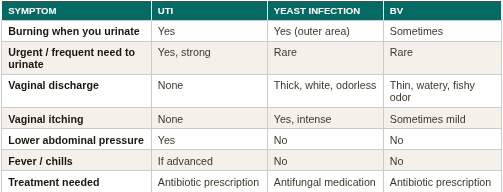
If you are genuinely unsure which you have, a telehealth provider can evaluate your symptoms and recommend the right treatment. This is exactly what the Practical Telehealth UTI, BV, and yeast infection visit is designed for. Flat $20, same-day prescription if appropriate, no guessing required.

The Signs Most Women Miss Until It Gets Worse
This is the part of the conversation that most UTI articles skip. They describe the classic symptoms, which you already know. But there is a second layer of signs that women regularly dismiss, normalize, or attribute to something else entirely. These are the ones that matter, because they are often what you experience before the unmistakable burning kicks in.
You feel tired and a little off, but nothing specific
A low-grade infection produces a systemic inflammatory response. Before the localized urinary symptoms become unavoidable, many women experience general fatigue, mild pelvic heaviness, or a vague feeling of being run-down. Most attribute this to stress, their cycle, or not sleeping well. It is easy to miss. If it is accompanied by any increased urinary frequency, pay attention.
You are going to the bathroom more often, but it does not hurt yet
Early-stage UTIs often produce frequency before significant pain. You might notice you need to urinate every hour rather than every few hours. The urgency feels unusual but not alarming. This is the window where treatment is easiest. A single course of antibiotics at this stage typically resolves a UTI within 48 to 72 hours.
Your urine smells different
Changes in urine odor are among the earliest signs of bacterial activity in the urinary tract. A stronger, more ammonia-like or pungent smell in your urine, especially paired with any frequency, is worth taking seriously. It is not a definitive sign on its own, but in the context of other mild symptoms, it is meaningful.
You have a UTI after sex and assumed it was normal
Post-coital UTIs are extremely common and are not a sign of anything unusual about your anatomy or your partner. Sexual activity pushes bacteria toward the urethra. Many women have had this pattern their entire adult lives, treated it occasionally, and never connected the dots that they are dealing with a recurrent, predictable, and preventable infection. If this is your pattern, mention it in your telehealth intake. There are preventive strategies that can break the cycle.
You thought it would go away on its own
This is the one worth addressing directly. Some mild UTI symptoms do resolve without treatment, particularly in otherwise healthy women. Research shows that roughly 25 to 50 percent of uncomplicated UTI symptoms improve spontaneously within one week. The problem is that you have no way to know which side of that statistic you are on without getting evaluated. And the UTIs that do not self-resolve tend to progress to kidney infections, which are considerably more serious and expensive to treat.
EXPERT INSIGHT
"Based on seeing how women describe their UTI histories, the pattern I notice most consistently is this: the first UTI was treated promptly, the second one was treated after a few days of hoping, and by the third, the delay was a week or more. Each infection that goes untreated longer has a higher chance of becoming a kidney infection and increases the likelihood of another recurrence. The single most important thing you can do when symptoms start is not wait."
Casey Hicks, FNP-BC, Practical Telehealth

What Happens When You Wait Too Long
An untreated bladder infection does not simply linger indefinitely. It has a progression, and understanding that progression is important for making a timely decision.
Stage 1: Bladder infection (cystitis)
The bacteria are confined to the bladder. Symptoms are uncomfortable but manageable: burning, urgency, frequency, lower abdominal pressure. A 3 to 7 day course of antibiotics resolves most uncomplicated cases completely. This is the stage where a telehealth prescription is the right and sufficient intervention.
Stage 2: Kidney infection (pyelonephritis)
If the infection ascends from the bladder to the kidneys, symptoms escalate significantly. You will typically develop fever (often above 101 degrees Fahrenheit), chills, nausea or vomiting, and a deep aching pain in your back or sides, below the ribcage. This is now a more serious infection requiring stronger antibiotics, sometimes intravenous treatment, and potentially hospitalization. A telehealth provider who sees these symptoms in your intake will direct you to in-person care immediately.
Stage 3: Sepsis (rare but real)
In rare cases, a kidney infection that goes untreated can allow bacteria to enter the bloodstream, causing sepsis. Symptoms include a rapidly escalating fever, confusion, extreme fatigue, rapid heart rate, and difficulty breathing. This is a medical emergency requiring immediate emergency room care. The CDC documents sepsis as a life-threatening condition that can develop from an infection anywhere in the body, including the urinary tract. It is uncommon from a UTI specifically, but it is real, and it is entirely avoidable.
WHEN TO GO TO THE ER INSTEAD OF USING TELEHEALTH
Seek emergency care immediately if you experience:
Fever above 101 degrees Fahrenheit with chills or shaking
Severe pain in your back, sides, or flank below the ribcage
Persistent nausea and vomiting
Confusion, rapid breathing, or heart rate that feels very fast
Symptoms worsening rapidly rather than holding steady
These indicate the infection may have moved beyond the bladder. Telehealth is the right tool for stages 1 and early stage 2. For the above symptoms, go in person.

Why the Emergency Room Is the Wrong First Call for a Bladder Infection
A lot of women without a regular doctor or without insurance default to the emergency room when symptoms become too uncomfortable to ignore. It is understandable. But for an uncomplicated UTI that has not spread to the kidneys, the ER is financially punishing and clinically unnecessary.
According to cost data analyzed by Goodbill, the average ER visit for UTI treatment costs $2,474 for uninsured patients. Some hospitals price it far higher. What you receive for that bill, in the vast majority of cases, is a urine dipstick test and a prescription for trimethoprim-sulfamethoxazole or nitrofurantoin, both of which are available for under $15 at a pharmacy with a GoodRx coupon.
The prescription itself is the clinical intervention. The ER building, the IV line, the three-hour wait, the facility fee -- none of that changes the medication or the outcome. You are paying thousands of dollars for the overhead of a facility designed for emergencies, not for the treatment of a bladder infection.
A telehealth provider can evaluate your symptoms, determine whether an antibiotic is appropriate, and send the prescription to your pharmacy the same day.

How to Get UTI Antibiotics for $20 Online Today
Practical Telehealth offers a flat-fee $20 visit for UTI, BV, and yeast infection evaluation and treatment. Here is exactly how it works and what to expect.
Step 1: Start your visit
Go to practicaltelehealth.org/virtual-uti-treatment and complete your purchase. The visit is $20 regardless of whether you have insurance. There are no hidden fees. No copay. No subscription.
Step 2: Complete your intake form
Fill out a short, HIPAA-compliant symptom intake form. You will describe your symptoms, when they started, any relevant medical history (including allergies and medications), and your preferred pharmacy. The more specific you are, the more tailored your provider's response will be.
Step 3: A licensed provider reviews your case
A board-certified nurse practitioner reviews your intake. This is asynchronous care: you do not need to be available for a live video call. The provider reviews your clinical picture, may send a clarifying question through the secure portal, and makes a clinical determination. This is real medicine, not an automated symptom checker.
Step 4: Prescription sent to your pharmacy
If the provider determines a prescription is appropriate, it is sent electronically to your preferred pharmacy. Most cases are reviewed within a few hours. You can use GoodRx to reduce antibiotic costs further. Trimethoprim-sulfamethoxazole (Bactrim), the most common first-line UTI antibiotic, is typically available for under $10 with a GoodRx coupon.
WHAT PRACTICAL TELEHEALTH CAN PRESCRIBE FOR UTI
Trimethoprim-sulfamethoxazole (Bactrim DS) -- First-line treatment for most uncomplicated UTIs. 3 to 7 day course. Widely available for $4 to $12 at pharmacy with GoodRx.
Nitrofurantoin (Macrobid) -- Common alternative, particularly for women who have had Bactrim before or where local resistance patterns favor it. 5 to 7 day course.
Fosfomycin -- Single-dose treatment for uncomplicated UTIs. Convenient for women who struggle with multi-day antibiotic courses.
Cephalexin -- Used in specific clinical situations, including UTIs in pregnant patients in eligible states where such cases are appropriate for telehealth management.
If your symptoms suggest BV rather than a UTI, your provider can also prescribe metronidazole or clindamycin for that. This is a single visit that covers the diagnostic uncertainty most women feel when they are unsure what they have.
STATES WE CURRENTLY SERVE
Alaska, Arizona, Colorado, Connecticut, Delaware, Hawaii, Idaho, Maine, Maryland, Massachusetts, Montana, Nebraska, Nevada, New Mexico, New York, Oregon, Rhode Island, South Dakota, Utah, Washington, Wisconsin, Washington D.C., West Virginia, and Wyoming.
Not on the list? Contact us at practicaltelehealth.org/contact and we will advise on your options.

What Genuinely Reduces Your Risk of a UTI Coming Back
Prevention is where a lot of well-meaning advice falls apart. You will find lists of tips everywhere that include cranberry juice, vitamin C, and wearing cotton underwear. Some of this has real evidence behind it. Some of it is noise. Here is what the research actually shows.
Urinate after sex
This is the single most evidence-supported behavioral intervention for preventing post-coital UTIs. Urinating within 30 minutes of sexual activity flushes bacteria that may have been introduced near the urethra during intercourse. Multiple studies have found sexual intercourse to be the most significant risk factor for recurrent UTIs in premenopausal women.
Stay well hydrated
Adequate fluid intake means more frequent urination, which mechanically flushes bacteria from the urinary tract before they can establish an infection. Aim for clear to pale yellow urine throughout the day. This is not a cure, but dehydration concentrates urine and creates better conditions for bacterial growth.
Wipe front to back
The proximity of the anus to the urethra in female anatomy means wiping direction genuinely matters. Always wipe from front to back after urination and bowel movements to minimize the transfer of enteric bacteria toward the urethral opening.
Avoid products that disrupt vaginal pH
Douches, scented feminine washes, harsh soaps, and similar products alter the vaginal microbiome and the pH environment of the perineal area. This does not directly cause UTIs, but a disrupted local bacterial balance makes it easier for pathogens to take hold. Water and fragrance-free soap are all you need.
Cranberry: the honest answer
Cranberry products (juice, capsules) contain proanthocyanidins, compounds that may inhibit E. coli from adhering to bladder walls. The evidence is mixed: some studies show modest benefit for recurrent UTI prevention, particularly in women with frequent post-coital infections, while others show no significant effect. Cranberry supplements are not a substitute for antibiotics when you have an active infection, but they carry no real downside as a preventive measure.
If you get UTIs regularly, talk to your provider about prophylaxis
Women with two or more UTIs in six months or three or more per year qualify as having recurrent UTIs. For these patients, a low-dose prophylactic antibiotic (taken daily or after sex) significantly reduces recurrence. This is a legitimate, guideline-supported clinical strategy that your Practical Telehealth provider can discuss with you. You can also reach us through the online primary care visit if your situation calls for ongoing management.
COMMON MISTAKES WOMEN MAKE WHEN THEY HAVE A UTI
Stopping antibiotics early because symptoms improve. The infection is still present even when you feel better. Complete the full course. Stopping early contributes to antibiotic resistance and recurrence.
Using an over-the-counter yeast infection treatment when you have a UTI. If you have a UTI, this will do nothing. The infection will continue to progress.
Assuming because it is not the worst UTI you have had, it will go away. Severity does not correlate reliably with whether it will resolve on its own. Mild infections can still ascend to the kidneys.
Waiting until you have a full day free to deal with it. A telehealth visit takes less than ten minutes of your active time. The sooner you start, the shorter and less severe the infection.

Frequently Asked Questions
Can I get a UTI prescription online without going to a clinic or urgent care?
Yes, in the states Practical Telehealth serves. A licensed nurse practitioner evaluates your symptoms through a HIPAA-compliant platform and, when appropriate, sends a prescription electronically to your preferred pharmacy. The visit costs $20 and requires no insurance. You can start at practicaltelehealth.org/virtual-uti-treatment.
How do I know if I have a UTI or BV or a yeast infection?
The clearest distinguishing factors: UTI symptoms are centered on urination (burning during urination, frequency, urgency, pelvic pressure, no vaginal discharge). BV produces a thin, grayish discharge with a distinct fishy odor. Yeast infections produce intense vaginal itching with thick, white, odorless discharge. Burning during urination can appear in all three, which is why they are easy to confuse. A telehealth provider can evaluate your full symptom picture and determine the most likely cause.
Can a UTI go away without antibiotics?
In some cases, yes. Research indicates that 25 to 50 percent of uncomplicated UTIs may resolve spontaneously within a week. However, you cannot predict in advance whether yours will be one of them. UTIs that do not self-resolve can progress to kidney infections. Given that treatment costs $20 and takes under ten minutes to initiate, the risk-benefit calculation strongly favors treating promptly rather than waiting.
What is the fastest way to get UTI relief?
The fastest path to relief is starting antibiotics as soon as possible. Most women experience significant symptom improvement within 24 to 48 hours of the first antibiotic dose. While waiting for the prescription or for the antibiotics to work, you can take phenazopyridine (AZO or Uristat), an over-the-counter urinary analgesic that numbs the urinary tract and reduces burning. It turns your urine bright orange and does not treat the infection, but it helps with the pain in the meantime.
I keep getting UTIs. What should I do differently?
If you have two or more UTIs in a six-month period, or three or more in a year, you have recurrent UTIs. This is a recognized clinical pattern with evidence-based management options, including post-coital prophylactic antibiotics or low-dose daily antibiotics. Mention your history of recurrences in your telehealth intake form. You can also book an online primary care visit to discuss a longer-term prevention plan.
Can I get a UTI prescription while pregnant?
UTIs during pregnancy require prompt treatment and careful antibiotic selection, as some first-line antibiotics are not safe in pregnancy. Mention in your intake form if you are or may be pregnant. Depending on your specific situation and the state you are in, your provider will determine whether telehealth treatment is appropriate or whether in-person evaluation is recommended.
Is the Practical Telehealth platform secure and private?
Yes. The platform is fully HIPAA-compliant. Your health information is encrypted, confidential, and never shared with your employer or insurance company. You do not need to use your insurance to access the service, and the visit will not appear on any insurance claim.

You Know What This Feels Like. You Also Know What to Do About It.
A UTI is one of the most common infections in the world. It is also one of the most under-treated, specifically because the women who get them most often are the ones who can least afford the barriers the healthcare system puts in front of a $10 antibiotic prescription.
Practical Telehealth was built specifically to close that gap. A $20 visit. A real licensed provider. A prescription to your pharmacy the same day if appropriate. No insurance, no waiting room, no $2,000 ER bill for something that takes seven days of antibiotics to resolve.
If you have symptoms right now, the most useful thing you can do is start your visit here. If you have other health concerns beyond a UTI, you can also explore our online primary care, virtual mental health, and cold and flu visits, all at the same flat $20 rate.
Do not wait three more days. You have already waited long enough.
Medical Disclaimer
This article is for informational purposes only and does not constitute medical advice. If you are experiencing symptoms of a kidney infection (fever, back pain, nausea, vomiting, chills) or symptoms that are rapidly worsening, please seek in-person medical care immediately. Telehealth is appropriate for uncomplicated lower urinary tract infections in non-pregnant adults in eligible states. Individual clinical suitability is determined by our licensed providers on a case-by-case basis. Not all patients will be appropriate candidates for a telehealth prescription.
